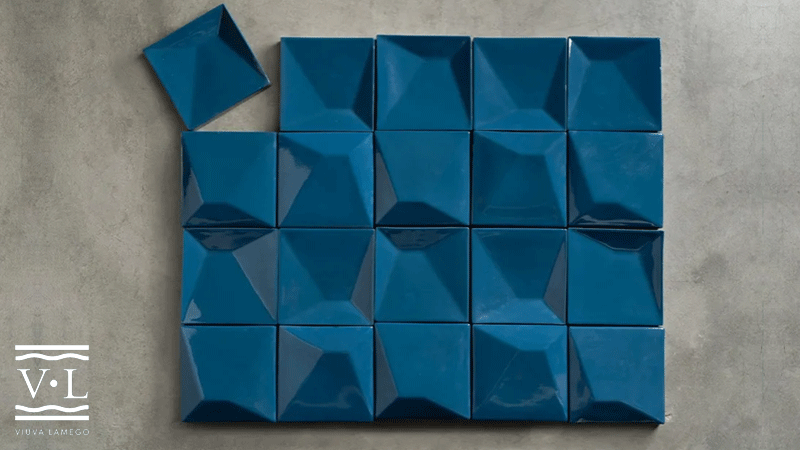
The Portuguese brand VIÚVA LAMEGO® holds a distinctive place in the history of Portuguese tilemaking, having accompanied for more than 175 years the evolution of one of the country’s most recognisable forms of artistic expression. Founded in 1849 by António da Costa Lamego, it began as a pottery workshop in Lisbon and later adopted the name by which it would become known when, following the founder’s death, his wife took over the management of the factory in 1876. Its connection to the city became embodied in the emblematic building on Largo do Intendente, whose façade, entirely clad in figurative tiles by Ferreira das Tabuletas, became a landmark of Lisbon’s urban landscape and one of the most striking examples of nineteenth-century Portuguese tilework. Across successive generations, the Portuguese brand VIÚVA LAMEGO® transformed ceramic tradition into a continuous space for creation, bringing together master craftspeople, artists, architects and designers and playing a decisive role in renewing the language of tilemaking in Portugal. Collaborations with figures such as Jorge Barradas, Maria Keil, Manuel Cargaleiro, Querubim Lapa and Álvaro Siza Vieira helped bring this ancestral material into new scales, buildings, public spaces and artistic languages, establishing a dialogue between heritage and contemporary creation that remains central to the brand’s identity. Today, based in Abrunheira, Sintra, its factory and atelier continue to approach tile as a living material, capable of preserving memory, interpreting place and engaging with different generations of Portuguese and international creators. More than producing ceramics, the Portuguese brand VIÚVA LAMEGO® preserves and reinterprets a distinctly Portuguese way of enriching architecture, telling stories through colour and drawing, and transforming surfaces into cultural heritage. In every project there remains a deep connection to Portugal, to its visual culture and to a tradition that has crossed centuries without losing its capacity to surprise.